Thursday, June 24, 2010

Galleries and museums face summer of protest over BP arts sponsorship

http://www.guardian.co.uk/environment/2010/jun/24/galleries-museums-summer-protest-bp-arts-sponsorship


Galleries and museums face summer of protest over BP arts sponsorship

Prestigious institutions defend links with oil firm as artists and green activists plan action
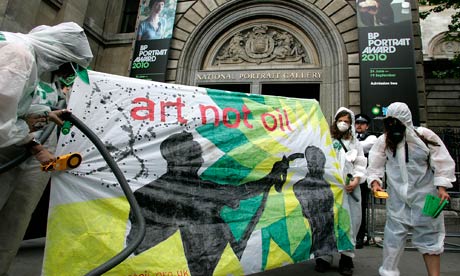
‘Greenwash Guerrillas’ protest outside National Portrait Gallery
‘Greenwash Guerrillas’ protesting outside the National Portrait Gallery. They want the gallery to stop accepting sponsorship money from BP. Photograph: Akira Suemori/AP
The summer season of events at Britain's most prestigious galleries and museums will be picketed by artists and green groups intent on portraying BP's arts sponsorship as a toxic brand.
Protests are planned next Monday by an eco-alliance styling itself "Good Crude Britannia" at Tate Britain's celebration of its 20-year association with the international oil conglomerate.
Climate change activists, artists and musicians opposed to the fossil fuel industry are determined to highlight BP's link to the arts in the context of the company's international embarrassment over the continuing oil spill in the Gulf of Mexico.
But the main recipients of BP's corporate largesse – the Royal Opera House, Tate Galleries, British Museum and the National Portrait Gallery – today issued a joint statement defending the connection and signalling their determination to preserve the commercial relationship.
The calls for cultural institutions to distance themselves from the oil industry comes at a time when government spending on the arts is about to be slashed amid efforts to cut public debt.
Many of Europe's leading artists, donors and cultural supporters are expected to be greeted at the glittering annual Tate summer party by Lord Brown of Madingley, chair of the Tate and former head of BP. . . .

Thursday, May 20, 2010

Carolyn Jervis discusses a "blindspot the audience and presenters had at [last week's 'The Politics of Art & Oil'] lecture – knowledge about who controls and influences the art we see in this town."

http://blog.latitude53.org/post/618024999/something-to-stew-over-the-meaty-question-of-who

OIL PAINTING: THE SUPREME DISCIPLINE OF ART. THE OIL SLICK, THE SIZE OF PUERTO RICO, IS BEGINNING TO PAINT COASTLINES

http://www.ubermorgen.com/DEEPHORIZON/statement.html


May 6, 2010
FOR IMMEDIATE RELEASE
OIL PAINTING: THE SUPREME DISCIPLINE OF ART. THE OIL SLICK, THE SIZE OF PUERTO RICO, IS BEGINNING TO PAINT COASTLINES
Digital Oil Paintings: http://UBERMORGEN.COM/DEEPHORIZON
The supreme discipline of art - oil painting - is back. It has been 13 days since a BP oil and gas exploration well blew out, setting fire to the drilling rig, which sank, killing 11 people. Ever since, crude oil has been leaking into the Gulf of Mexico, raising the prospects of a historic environmental disaster. Winds from the southeast have nudged the slick northward, where it floated Saturday near the coasts of Louisiana, Alabama and Mississippi and has begun to paint the coastlines.
Finally oil painting has evolved into generative bio-art, a dynamic process the world audience can watch live via mass media. Never before has this art form been as revelant and visible as today - only 9-11 was nearly as perfect, but in the genre of performance art. An oil painting on a 80.000 square miles ocean canvas with 32 million liters of oil - a unique piece of art.
We exclusively use aeriall images from the oil spill. The files are ready-mades but we waived our right to use them "as is" and decided to use a special digital technique to produce a statement about the disconnection of form and color and about contemporary and futuristic imaging procedures. We use a compressor (sorenso codec) and consumer video editing-software and manually loop 2 frames, the image becomes liquid, transforms and deformes. These visualisations represent the "Verkuenstlichung" of nature and the "Vernatuerlichung" of art. Unedited oil-paintings of the event can be found via search-engines, on boston.com or on the NASA Earth Observatory website.
UBERMORGEN.COM are well known for similar projects. What they wanted to achieve with these alienating and retro-visual "web-paintings", as they call it, is not clear. "Since we work for digital penetration of the art market " declared Hans Bernhard "we should get used to radical changes of our networked point of view and in particular about new forms of digital painting".
"I saw the NASA earth observatory images and I was blown away", lizvlx stated "Finally traditional painting made its comeback as a high-tech innvovative art form and not as the starving grandparent of photography, video, digital art and performance. As a former painter I am thrilled and as a digital artist I want to work this material until it bleeds".
"We're breaking new ground here. It's hard to formulate a defense for an artwork exploiting a human caused desaster that has no precedent, which is what this is," Curator Felix Vogel said, defending the artist duo UBERMORGEN.COM against not writing a response for "what is just a shift of perspective what you couldn't anticipate, but possibly with big impact on the art business."
After the images and the video circulated online the feedback hit hard on UBERMORGEN.COM: "It is perverted and sick to compare a mass media spectacle and natural desaster with the century old tradition of fine art painting" comments a curator who chose to remain anonymous "it is obvious that this comes from the ice-breaking european techno-art avant-garde. They step onto our fine tradition without the slightest idea of the consequences - and i am not talking about the butterfly effect"!
UBERMORGEN.COM have a record of experimental projects and radical positions. In 2001 they broadcast a live-webpainting "Attack on Democrazy" during the first 8 hours of the 9-11 attacks. They intuitively understood that the attack was a mass media intrusion, a "Media Hack". They are infamous for their Vote-Auction Media Hack, featuring the buying and selling of individual votes during the presidential election Al Gore vs. G.W. Bush in the year 2000. Since 2001 they work on different series of web-paintings, by definition non-functional websites serving as images rather than interactive document-structures.

Nightmare Scene of Oil Unfolding in Wetlands Oil slick hits wetlands, threatens Florida

http://www.commondreams.org/headline/2010/05/20

Greenpeace activists scale BP's London headquarters in oil protest

http://www.guardian.co.uk/environment/2010/may/20/greenpeace-activists-scale-bp-building-roof

Wednesday, May 12, 2010

Perspectives on the Conclusion of the Syncrude Duck Trial

http://www.cbc.ca/canada/edmonton/story/2010/05/12/edmonton-syncrude-ducks-trial-white-closing-arguments.html


Greenpeace Statement on Conclusion of Syncrude Duck Trial
Share
“The Syncrude dead ducks trial has shown the public the gapping holes in the government’s regulatory framework for a toxic tar sands industry. It is unacceptable that the Stelmach government allows a tar sands giant like Syncrude to comply with its environmental approval just by submitting a waterfowl protection plan even if that plan is never approved or implemented.

Tar sands companies are violating Canada’s environmental legislation 'every hour of every day' creating a sprawling toxic mess of tailings ponds that is poisoning our landscape, downstream communities and a vast river system and the government is allowing them to do it.

Even if Syncrude were found guilty and given the maximum fine, which Syncrude could pay off in a few hours of profits, justice will not be served. A guilty verdict would not force Syncrude to close its toxic tailings lakes, government would not be forced to take any responsibility and we all would still be left with a toxic mess. Justice will not be done until the government shuts down the tar sands and moves to a green energy economy.”

Tuesday, May 11, 2010

Roughneck, Bruised Head: A Tale of Women, toughness and safety in Alberta's gas fields

http://parklandinstitute.ca/post/story/roughneck_bruised_head/

Roughneck, bruised head

A tale of women, toughness and safety in Alberta's gas fields
Chantal Desharnais is no stranger to the outdoors or manual labour.
The 24-year-old Quebecker had previously worked in construction and once spent a summer picking fruit for income on the banks of a B.C. river. Despite this, she had reservations about going to Calgary to work in the natural gas industry for the summer.
It was the moral dilemma of working in an industry she had ethical disagreements with, and not the physical labour, that concerned the university student. However, as many before her, the lucrative work would allow her to make enough money to cover her tuition and help with student loan debts.
But while she was prepared for the physical rigour of the work, Desharnais never expected the sexism she would face or the serious injuries she would sustain. After one month on the job, she would need to be transferred to an office job in Calgary after suffering a concussion, receiving five stitches to the back of her head, and severely spraining her shoulder.
Despite what seems to be an ample need for workers in the Alberta oil and natural gas fields (the natural gas industry in Canada alone employed 151,327 people in 2006 and is growing), Desharnais found it difficult to get hired once she hitchhiked her way out to Calgary. Company after company refused to grant her an interview.
While most companies were coy about the reasons why, she says it was clear that they weren’t interested in hiring women. Eventually, however, she started asking companies outright if they had a policy of not hiring women. While she says she sensed hesitation when she first contacted Geokinetics, her eventual employer, their human resources and personnel manager claims the company never refuses to hire women.
“We never refuse to hire someone if they are a woman - we’re an equal opportunity employer,” says Stephen Menchuk, who hired Desharnais and is familiar with her case.
Interviewed at the end of June, Desharnais was at work by the beginning of July, flown out to the base-camp in Grand Cache, Alberta, where the geological exploration company was checking for natural gas deposits. She was one of only two women on the crew, and says she felt it right away. Beyond what she saw as a culture of "only the tough survive," the fact she is a woman seemed to make it all that more thrilling for others to see her fail.
"As people get off the bus, you can tell they’re judging how long they’ll last. Once you’re there for a while, you start to hear the comments too. It’s especially hard for women."
The challenges started almost immediately, she says. For the first two days she worked with the other rookies on the line crew, following the machines clearing brush to lay the explosive line behind it. But on the third day, she was sent out as a trouble-shooter alongside a 15- year company veteran known for taking few breaks and working long hours.
While line crew follow tracks already cleared by machine, trouble-shooters clear their own path, going from one trouble spot in a detonation line to another. By the end of the day she was exhausted and demoralized.
Upon returning to the camp, two of the older colleagues asked how her day was.
"When I told them I was out with Paddy, they burst out laughing, like it was some inside joke," she says. None of the other new employees were sent out as trouble- shooters.
Despite the tough day, Desharnais stuck with it and was eventually transferred to work with someone a little more easy- going. Then, towards the end of the month, she was transferred back to line crew. While the work atmosphere was still far from comfortable, she felt the worst had passed. But after only three more days on line crew, she was once again unexpectedly reassigned, this time as a shooter’s helper.
But according to Menchuk, there was another reason for her constant reassignment.
"I didn’t want to tell Chantal this to her face, but I’ve been told that she just couldn’t handle the work out in the field. She isn’t very big and it’s tough work carrying 30 pounds of equipment through the field and up mountains. I was told she just couldn’t keep up. Transferring her to shooter’s helper was to give her a chance; she would just need to follow behind and clean up after him."
But Desharnais says she was constantly at the head of her group and was told, along with one other colleague, to slow down so the others could keep pace. And while working as a troubleshooter or a shooter’s helper meant carrying less equipment, it wasn’t easier in terms of cardiovascular demands or the safety issues involved.
"It was clear that they wanted to put me in a difficult position," she said.
The job of a shooter is to detonate underground explosives sending out seismic waves to see if there are gas or oil deposits; a shooter’s helper is a kind of a sidekick, helping to set up the area, and clear away the wires after the explosion. Desharnais was assigned as a shooter’s helper in the morning, and, according to her, was not given proper training except for one colleague who offered her some advice on what equipment to bring.
According to Menchuk, all employees receive internationally recognized training at the beginning of their employment and are updated in the field. While he wasn’t on the ground in Grand Cache, he says he couldn’t imagine someone being sent out without proper training.
Attempts were made to contact Desharnais’ on-site supervisor, but Menchuk said he is currently out of the country and not available for comment.
Upon arriving on site her partner, the shooter, had no time to show her the ropes, says Desharnais. After being dropped off by helicopter, they walked half-an-hour into the bush to the site where they would be detonating explosives. When one of their two walkie-talkies died, the functioning one was given to her partner. She stayed back while he went to lay and detonate the explosives. All along, however, she assumed she would receive some kind of warning that the detonation was about to go.
"All of a sudden the explosion went off, with debris in the air. All I remember was being hit in the head and the shoulder," she says.
While Menchuk says he was informed she was 30 metres from the explosion (the required distance) and behind a tree, Desharnais says she can’t really be sure how far she was because she was never signaled where the explosion was coming from. Upon returning to find her, her colleague radioed in that she had been injured.
"But he would only say I had hurt my shoulder, and not that I thought I was hit in the head. He told me the blood on my neck was just from scratching it on branches when I fell," she says.
"Even I didn’t really know the extent of my injuries until I got into the helicopter, but I knew I had hurt my head,” she continues. “It was only once I saw the look of the pilot when I took off my helmet in the helicopter and the blood started going everywhere.”
The impact of the collision with the rock had cracked part of her helmet and cut her head badly enough that she would need five stitches once back at the base-camp, and would eventually be diagnosed with a severe concussion.
Menchuk says this type of injury is rare and a first for a shooter’s helper (Desharnais disputes this and says she had been told of others being hurt in the field).
"We do everything we can to ensure our employees' safety," he said. "But as I tell everyone, in the end you need to be aware of your surroundings. No one wanted Chantal to get hurt, and we’re sorry that she did."
Desharnais sees something more troubling. She feels that if she was a man perhaps her co-worker would have paid more attention when she said she had injured her head and not just her shoulder. "They just seem to think you complain for nothing."
Menchuk agrees that it is not always easy for women in the oil industry.
"It’s both the work and the atmosphere," he says. "You’re sending out a woman with a crew of 50 other guys. Issues come up, things like separate bathrooms and you need to share with the cooking crew because there are only three toilets on site."
Diagnosed with a sprained shoulder and receiving five stiches to the back of her head, it was unclear for three days, before she was able to return to Calgary, whether she had a concussion. While she was X-rayed in Grand Cache, there wasn’t a head trauma expert at the hospital who could tell her the extent of her injuries.
Desharnais’ troubles didn’t end with the injuries. According to Menchuk, Desharnais “declined” to go back out to the site when safety personnel went with her partner to examine the area in order to file an incident report. Desharnais remembers it differently.
"They asked if I wanted to go with them, and I said, 'Yes.' I wasn’t feeling well [from her injuries] and went to lie down. I found out later that they had gone without me.” The ensuing reports, except for the one she wrote herself, were based mostly on the shooter’s account of the incident and downplayed the lack of training she received and the lack of communication on site. She still has copies of the reports she refused to sign because of her disagreement on the facts.
It is clear that many may think that Desharnais’s complaints are simply sour grapes because she was hurt on the job. Menchuk claims he isn’t sure why she is still pursuing the matter.
"We treated her the way we would treat any employee. She decided to quit her modified work load [an office job in Calgary given to her at full pay after her injury] and go back to Grand Cache to try and convince her supervisors to change their reports. We’re sorry for what happened, but there isn’t much we can do now."
But in an industry that is continuing to grow, Desharnais feels stories like hers need to get out. It isn’t about the fact that the work is hard, she says, or even that she got hurt. It’s about the fact she wasn’t properly trained and her safety wasn’t ensured in the field, something she believes is largely because she is a woman.
"I may keep looking into this and talk to lawyers. But really I just don’t want to see this happening to anyone else."
This article first appeared in the Dominion newspaper, Nov. 27, 2007.

Greenpeace Report: Tar Sands in Your Tank

http://www.thegreenpages.ca/portal/ca/2010/05/greenpeace_report_tar_sands_in.html

Canada's tar sands: a dangerous solution to offshore oil

http://www.guardian.co.uk/commentisfree/2010/may/11/alberta-california-tar-sands-oil

Friday, March 5, 2010

Canwest accused of unethical ads

http://www.ffwdweekly.com/article/news-views/news/canwest-5216/

Sierra Club files complaint over unlabelled Canwest oilsands ad features

http://www.google.com/hostednews/canadianpress/article/ALeqM5jMY4dqpvvB9ei7DxY71o6LXXlD4A

Sierra Club files complaint over unlabelled Canwest oilsands ad features

Indigenous voices challenge Royal Bank tar sands policies, supported by hundreds at shareholder meeting

http://rabble.ca/blogs/bloggers/joshua-kahn-russell/2010/03/indigenous-voices-challenge-royal-bank-tar-sands-policies

Indigenous voices challenge Royal Bank tar sands policies, supported by hundreds at shareholder meeting

| March 4, 2010

On March 2, more than 170 people rallied outside of the Royal Bank of Canada's (RBC's) Annual General Shareholder meeting (AGM) in Toronto after a series of creative non-violent actions all morning. Inside, First Nations Chiefs and community representatives from four different Nations demanded RBC phase out of its Tar Sands financing and to recognize the right to Free, Prior and Informed Consent for Indigenous communities. Afterward, Indigenous leaders lead the crowd in a march to rally outside both RBC Headquarters buildings.

Other cities across Canada supported the First Nations voices inside the AGM as well with solidarity actions from (click on a city for pictures) London, Calgary, Vancouver, Edmonton, Victoria and more. Check out photos from those and our events in Toronto.

And see some preliminary media coverage from the Wall Street Journal, Yahoo, the Edmonton Journal and the Dominion.

Since 2007 RBC has backed more than $16.7 billion (USD) in loans to companies operating in the tar sands-more than any other bank. Called, ‘the most destructive project on Earth,' Alberta's tar sands projects will eventually transform a Boreal forest the size of England into an industrial sacrifice zone complete with lakes full of toxic waste and man-made volcanoes spewing out clouds of global warming emissions.

Outside the shareholder meeting school children, bank customers of every age, First Nations community representatives joined Rainforest Action Network, Indigenous Environmental Network, No One Is Illegal and Council of Canadians made their outrage at RBC's investments heard -- to the thumping beats of street Samba band, the crowd shouted "Cultural Genocide: who do we thank? Dirty investments from Royal Bank!"

Inside the shareholder meeting, Chief Al Lameman of Beaver Lake First Nation, Alberta,Vice Chief Terry Teegee of the Carrier Sekani Tribal Council of BC, Hereditary Chief Warner Naziel of the Wet'suwe'ten First Nation of BC, and Gitz Crazyboy of Athabasca Chipewyan First Nation addressed RBC CEO Gordon Nixon directly about the way tar sands extraction projects have jeopardized their health and their rights.

Downstream communities have experienced polluted water, water reductions in rivers and aquifers, declines in wildlife populations such as moose and muskrat, and significant declines in fish populations. Tar sands has all but destroyed the traditional livelihood of First Nations in the northern Athabasca watershed.

RBC is clearly feeling the public pressure over their tar sands financing. They spent half their shareholder meeting addressing the issue. Recently, the bank convened a high-level meeting with more than a dozen international banks for a 'day of learning' about the reputational risks associated with the tar sands. In addition, according to information the bank provided to RAN during a February meeting in San Francisco, RBC is currently evaluating new lending criteria that would apply to the oil and gas sector, in particular to the tar sands. However, the bank has been reticent to include Free, Prior and Informed Consent in its policy, which would ensure that First Nations communities are respected in lending practices.

"RBC's significant financial relationship with companies pursuing tar sands development activities within our traditional territory and without consent warrants close attention," said Chief Al Lameman of Beaver Lake First Nation. "RBC should update their policies to include a recognition of Free, Prior and Informed consent for Indigenous communities; this globally recognized concept was adopted by TD Bank Financial Group in 2007 and is endorsed by Indigenous communities across the political spectrum."

Internationally, tar sands financing is gaining tremendous negative attention. An increasingly vocal group of shareholders and environmentalists turned last month's BP, Shell and Royal Bank of Scotland annual meetings into a referendum on the oil extraction projects.

This week's marches, rallies and actions were a triumphant roar of grassroots power from across the spectrum. The day concluded with an apt chant to RBC Headquarters, foreshadowing the growing flame of tar sands resistance across Canada, "Native communities under attack! We won't stop until you act!"

Green groups give Avatar Oscar for "exposing tar sands"

http://communities.canada.com/SHAREIT/blogs/politics/archive/2010/03/04/green-groups-give-avatar-oscar-for-quot-exposing-tar-sands-quot.aspx

Canadian firms upset with oilsands-slamming ad in Variety


http://www.edmontonjournal.com/business/Canadian%20firms%20upset%20with%20oilsands%20slamming%20Variety/2642388/story.html

Sunday, February 28, 2010

Brenda Kim Christiansen

http://brendakim.com/

Sherri Chaba

http://www.sherrichaba.com/

British firms face onslaught from tar sands campaigners

http://www.guardian.co.uk/business/2010/feb/28/canada-tar-sands-investor-protest

British firms face onslaught from tar sands campaigners

Lobbyists bid to turn RBS, BP and Shell annual meetings into green referendums

Tar sands protesters, Canada House, London

A protester wearing a mask of Canadian prime minister Stephen Harper brandishes a barrel of oil over protesters dressed as penguins outside Canada House in Trafalgar Square, London. Photograph: Teri Pengilley

British companies spearheading the drive to exploit the Canadian tar sands will come under renewed assault this week from an increasingly vocal group of shareholders and environmentalists who are planning to turn the forthcoming BP, Shell and Royal Bank of Scotland annual meetings into a referendum on these controversial operations.

The Co-operative and the Fair Pensions lobby group are releasing a special briefing paper designed to counter recent statements by the oil companies that sought to justify their involvement in carbon-intensive oil extraction in Alberta on the basis that it was needed to meet rising oil demand.

Friends of the Earth, Platform and other green groups are publishing a new report, Cashing in on Tar Sands – RBS, UK Banks and Canada's Blood Oil, which claims RBS has provided loans of $7.5bn (£4.9bn) in the past three years to companies carrying out this kind of mining in North America.

There are signs the oil companies and the Canadian government are becoming increasingly concerned about the reputational damage that could be inflicted on them: a special "tar sands day of learning" was held at the headquarters of the Royal Bank of Canada in Toronto on 1 February to bolster the confidence of fellow bankers and investors.

The Co-op's investor briefing, designed to rally further opposition, warns institutional investors with highly diversified portfolios that allowing BP and Shell to pursue their costly tar sands extraction could undermine their holdings in other areas of the economy.

"The issue for many large investors is not just whether the macroeconomic conditions necessary to ensure the profitability of oil sands production are in place, but whether the continued expansion of oil sands production could aggravate climate change, thereby putting at risk gross domestic product growth and the performance of their portfolio as a whole," says the new document.

Fair Pensions last week announced the establishment of a new web tool allowing individual pension holders to lobby their fund managers, who are big investors in BP and Shell. More than 1,200 people have taken advantage of it on www.countingthecost.org.uk.

The Friends of the Earth and Platform report is being released tomorrow, on the day a coalition of non-governmental organisations seeks a judicial review against the Treasury over its willingness to allow RBS to finance companies alleged to be exacerbating climate change and disregarding the human rights of local indigenous peoples. RBS is now largely publicly owned and the NGOs believe the government could stop it from acting in ways that are counter to its climate-change policies.

Tar sands oil has soared up the investment, political and environmental agenda since the Copenhagen climate change summit highlighted the need for a clampdown on the most carbon-intensive activities that are the biggest threat to global warming.

Shell, a leader in the tar sands business, had shown signs of backtracking in recent months, with new chief executive Peter Voser saying: "We look at them as being developed, but at a much slower pace." But the company will still go ahead with plans to increase production by 100,000 barrels a day, which it is said will raise CO2 emissions from its current level of 3.7m tonnes a year to 5m by 2015.

BP is more bullish than ever: chief executive Tony Hayward said it could be getting 100,000-200,000 barrels a day from tar sands by 2015 and was already preparing two US refineries specially to process this kind of crude.

Despite mounting opposition from politicians, as well as some investors and non-governmental organisations, Hayward is convinced: "Canadian heavy oil is going to be a very important part of America's energy."

But not if the Co-op and Fair Pensions can help it. They have had a resolution accepted for BP and Shell's AGMs, asking both companies to undertake reviews on the risk of tar sands extraction, with reports to be made to the 2011 AGMs.

The BP resolution wants details of "assumptions made by the company in deciding to proceed with the Sunrise [tar sands] Project regarding future carbon prices, oil price volatility, demand for oil, anticipated regulation of greenhouse gas emissions and legal and reputational risks arising from local environmental damage and impairment of traditional livelihoods".

Both BP and Shell insist that they can extract oil from tar sands in a responsible way, with the latter arguing that CO2 emissions can be minimised by using carbon capture and storage (CCS) techniques. Shell says a planned CCS plant in Edmonton, Alberta would take more than 1m tonnes a year out of the atmosphere by 2015 and could be expanded in future.

Tar sands, or oil sands, are deposits of sand and clay saturated with bitumen, which is oil in a solid or semi-solid state. The region where they have been found, in the ancient forests of Alberta, is said to cover an area bigger than England. When the bitumen is close to the surface it is excavated in an opencast mine. The land is cleared and the bitumen-soaked sand is dug out with mechanical shovels and loaded on to trucks to be taken to a separation plant.

BP stresses it does not get involved in such controversial strip-mining, but bringing the oil out from deeper deposits has its own serious problems: it requires power and steam-generating plants that use a lot of energy and water. In some cases, steam has to be injected into wells to encourage the bitumen to flow.

BP claims the method of production used in the Sunrise Project only emits 5% more greenhouse gases than commonly imported conventional fuels. But the Co-op says the Jacobs report, which is quoted by the oil company in support of these figures, is "subject to challenge" because it has not been peer-reviewed.

"Peer-reviewed studies and US government studies show that the relative emissions of oil sands are much higher than BP claim," says the briefing paper, which questions the companies' assumptions that global oil prices will remain high enough in future to justify the heavy investment costs of bringing oil out of the ground in this way.

Analysts at Deutsche Bank recently pointed out that continuing high oil prices – currently close to $80 per barrel – could trigger a permanent switch to more efficient oil use and low-carbon alternatives: "The value of high capex [capital expenditure] intensity, long lead time, currently undeveloped oil such as undeveloped Canadian heavy oil sands … could be far lower than the market expects."

The involvement of a major investor such as the Co-op in the campaign against tar sands is relatively new, but back at its 2008 annual meeting Shell was accused by an individual shareholder of "selling suicide on the forecourt".

Comment, page 52

Thursday, February 25, 2010

How to Watch a Documentary

http://www.utne.com/Arts/How-to-Watch-a-Documentary.aspx

How to Watch a Documentary

Take it from a pro: What you don’t see matters

Watch a documentary
image by Brian Hubble / www.brianhubble.com
Article Tools
Bookmark and Share

During my first year as a documentary producer, my brother went to Africa as an aid worker, packing a video camera to cover the civil war in Sudan. I volunteered to construct a documentary from his footage, partly out of love for my brother and partly to assuage my guilt for engaging in a consumer-driven industry often at odds with the values we learned from our Christian hippie parents. My brother sent tapes and I spent many late-night hours trying to condense a complicated civil war into 30 minutes.

RELATED CONTENT

The color correction process was directed by a colleague who loved hard rock. I checked on his progress one night and found him jamming out to Led Zeppelin while images of people in crisis flashed across the screen. “Take a look,” he said, pointing to an aerial image of Sudan’s dusty savanna. Adjusting the color saturation to green, he asked, “Would you like it to look lush and fertile, or,” changing it to harsh brown, “dry and desiccated?”

That moment was a turning point for me. I realized that humanitarian subject matter didn’t make a film immune to manipulation. Every image was persuasive text. Every creative decision was an ethical judgment. Every opportunity to move viewers was also a chance to manipulate them. With a powerful medium in my hands, I was playing with portrayal and perception—the portrayal of war victims whose complicated story ended up in my hands, and the perception of the viewers who had no idea what went on behind the wizard’s curtain of documentary production.

I committed then to studying the medium. I read media studies literature, continued work on the Sudan documentary, and wrestled with the ethics of filmmaking. Two basic categories of analysis emerged.

First, juxtaposition and decontextualization. Russian filmmaker Sergei Eisenstein defined the idea of “dialectical montage” in film editing. He composed his theory in part using the Kuleshov Experiment in which the same image—an actor’s face with unchanged expression—was shown in juxtaposition with other images. When the face appeared next to an image of food, the test audience said that it was expressing hunger. When the same face was shown next to the image of a woman in a coffin, the audience interpreted the facial expression as grief. Eisenstein concluded that two unrelated images put together in collision create a new, third “idea.” Placing shots in a new context is part of what makes editing a creative process, and a potentially misleading one.

In the Sudan piece, I cut together an image of a girl hiding behind a tree, crying, with an image of gun-carrying soldiers. When they are combined, these images give an impression of human vulnerability in the face of war.

What young activists and student journalists can teach the old guard....

Did those scenes occur in the same spatio-temporal zone? No. Was I creating a false impression? Yes—but for the purpose of evoking emotion about the effects of war. Did I breach ethical bounds? The answer to that question is part of the great ethical complexity of being a documentary filmmaker and a film viewer. As a critical viewer, you have to know how to step into and out of the constructed emotions of a film.

The second category of analysis is inclusion and exclusion. In his book Introduction to Documentary, author Bill Nichols analyzes the way in which documentaries convey information and seek to persuade an audience. Images make arguments. In the Sudan documentary, I made the argument that the North was oppressing the South. I excluded a statement from an interviewee sympathetic to the North (who said “child abduction [by Northern soldiers] is an unfounded myth”) while including a statement from an interviewee sympathetic to the South (who said “child abduction is going on”). I illustrated the statement with footage that gave the impression of slavery.

As a viewer, you can’t see inside the edit suite, but analyzing what might have ended up on the cutting room floor matters as much as analyzing what you see on screen. Viewers should ask: What has been included, and why? What has been excluded, and why? Who gets the final say? Does the director have a strong agenda? What argument is being made by the images?

Media theorist Marshal McLuhan famously said “the medium is the message.” The image-based medium offers a paradigm that operates largely on impression and emotion; its moving im-ages deliver not only raw data but also an entire experience that can shape our fundamental perspectives about life. Getting inside the gears is part of becoming active thinkers and critical viewers.


Excerpted from Geez (Fall 2009), a playful yet profound Canadian magazine that was honored for best spiritual coverage in the 2009 Utne Independent Press Awards. www.geezmagazine.org


Oilsands output ramping up Syncrude, Imperial planning for 20% production increases

http://www.edmontonjournal.com/business/Oilsands%20output%20ramping/2611174/story.html

Friday, February 19, 2010

Thursday, February 4, 2010

The Three Functions of Public Art

http://hewittandjordan.com/work/vitrine.html


The Three Functions
are:
The economic function of public art is to increase the value of private property.
The social function of public art is to subject us to civic behaviour.
The aesthetic function of public art is to codify social
distinctions as natural ones. *


Riley's Bar and Snooker Hall, Cross Belgrave St, Leeds

This is the first time the three text works that form the Three Functions have been presented together.

We have been working on the Three Functions for over a year.We did not set out to make this a long-term project; in fact the first function felt like a culmination of a previous project rather than the beginning of a new one. The project began as the second phase of a commission for Public Art Forum’s (now ixia) annual conference in April 2003. The first part of the commission, a work called I won an artist in a raffle, was concerned with initiating a debate about the commissioning of public art; conference delegates were entered into a raffle in which they might win the opportunity to commission us to make a new work within their home or work place. The winner was Allia Ali, who after some discussion on how we might collaborate, said “just make a work for me, you can make what you like”. We went on to write and display The Economic Function of Public Art. The text became a billboard poster, sited in Sheffield, and a contribution to the book Desirable Places: The Contribution of Artists to Creating Spaces for Public Life. The subject of the Three Functions is public art. The aim of the work is to examine the tensions and contradictions that exist within public art practice; to explore how public art is integral to our culture and therefore how it functions in support of the dominant ideology. In order to reveal the hegemony within culture, we chose to describe how public art functions in the broadest of cultural contexts: economic, social and aesthetic. The Three Functions state - in the direct and reductive manner of a one line slogan - ideas of public and private, social responsibility and expected good behaviour as well as divisive forms of knowledge, like taste. The Three Functions attempt to initiate a discourse around how art maintains cultural division.


Leeds City Art Gallery


Merrion Centre, Merrion Street, Leeds

For Vitrine, the Three Functions are three posters that exist both within this book and as a series of window displays in Leeds city centre.

The great thing about text works is that they are easy and cheap to reproduce. They can also take many forms, use a range of media and they can exist almost anywhere. We would like the posters in this publication to be removed and used; for us, the more often the texts are distributed, copied and discussed the better.

A major contribution to this work is the essay Sloganeering by artist Dave Beech, in which he asks the question, most cogently, “Public art exists. What does it do?” We would especially like to thank Dave for his collaboration on the development of the Three Functions project.

The Three Functions are:
The economic function of public art is to increase the value of private property.
The social function of public art is to subject us to civic behaviour.
The aesthetic function of public art is to codify social
distinctions as natural ones. *

Andy Hewitt and Mel Jordan

The Three Functions poster publication including the three posters and Dave Beech's essay was printed in an edition of 500. It is available from publications@hewittandjordan.com for £5.00 plus postage.

Sloganeering by Dave Beech (download pdf, 60kb)

Click on an image to download a pdf of the poster


* The Aesthetic Function of Public Art is in collaboration with Dave Beech


Vitrine is an 18-month curatorial project for Leeds by Pippa Hale and Kerry Harker. From November 2004 to April 2006, they are staging a series of contemporary visual arts exhibitions in ‘vitrines’ (glass display cabinets) in public spaces around the city centre. The project aims to provide new exhibition and commission opportunities to artists based in the city and the region, to engage with siting art in non-gallery spaces and to explore the role of art in public space.

Three Functions has been commissioned by Vitrine and will be on show from 13th May - 8th July 2005. This will coincide with Situation Leeds: Contemporary Artists and the Public Realm, 16th - 29th May 2005.

Vitrine

Saturday, January 23, 2010

Guardian Overview of Burtynsky's Oil

http://www.guardian.co.uk/environment/gallery/2009/oct/12/edward-burtynsky-oil-photography

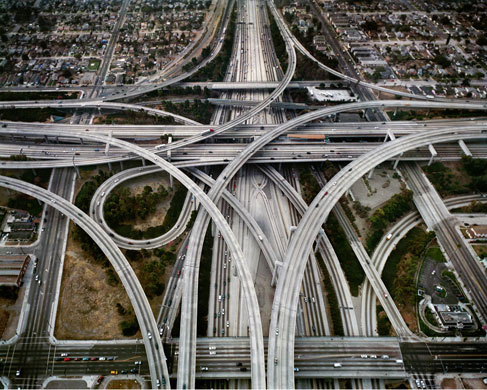
Edward Burtynsky Oil: Highway #1, Los Angeles, California, USA, 2003

Thursday, January 21, 2010

The Making of 20:50

http://www.guardian.co.uk/artanddesign/2003/apr/04/thesaatchigallery.art3

The birth of a notion

Nothing in the Saatchi collection has aroused such wonder and delight as the work 20:50. This is its story, by the man who made it

20:50, Saatchi Gallery, July 2000

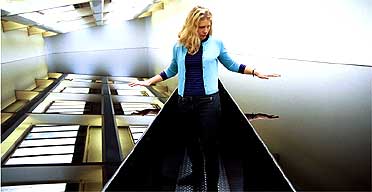
Wilson's 20:50. "The gallery is filled to waist height with recycled engine oil, from which the piece takes its name. A walkway leads from a single entrance, leading the viewer into the space until they are surrounded by oil on all sides." Photo: Sarah Lee

The idea of a Tardis-like space, where the internal volume is greater than its physical boundaries, had always appealed to me. That was how the idea for 20:50 came about. I've always been concerned with the ways you can change architectural space - whether it be a room or a whole building - to alter your perception, to knock your view of the world off-kilter.

The central idea finally came to me after weeks beside a swimming pool, during a holiday in the Algarve. I was due to make a new piece for Matt's Gallery in the east end of London when I returned, and over the weeks I became increasingly fascinated with the horizontal surface of the pool. One day it hit me, and I thought: "I know - I'll flood the place."

The oil became part of the piece because I knew it had a highly reflective surface. There had been a drum of the stuff sitting in my old studio, without a lid, that I'd been meaning to get rid of. In the meantime, all sorts of rubbish had accumulated around it, and I always loved the way that among all these bits of junk there was this void, this perfect reflection. That was the final piece of the jigsaw.

In 20:50, the gallery is filled to waist height with recycled engine oil, from which the piece takes its name. A walkway leads from a single entrance, leading the viewer into the space until they are surrounded by oil on all sides. The seemingly impenetrable surface of the oil mirrors the architecture of the room exactly, placing the viewer at the mid-point of a symmetrical visual plane. One of the first people to see 20:50, a man who was delivering paper to the gallery, asked me how he could get downstairs: he thought he was looking into another gallery beneath the walkway. When I dipped my finger through the surface of the oil, his jaw just dropped.

20:50 was first made 16 years ago. Matt's was probably the only gallery willing to do something so experimental at that time. This was, after all, the 1980s, and no one was really doing installation work: the trend was towards object-based sculpture. I remember the gallery owner hanging about nervously while I drove around trying to find waste oil and a pump I could use to get the oil into the tank. And then we looked at it and we were really astounded. We thought it would be good - but it was incredible.

Despite the fact that there were queues around the block right from the start, the great difficulty with something like this is selling it. It's still hard to place some of my work now, but back then, before Charles Saatchi came along, people would ask me perplexed questions like: "But how would you move it?" Charles saw it, and he just said: "I want that. Can you make me one?" He really was a pioneer: there were collectors of installations in other countries, but no one in Britain really seemed to understand that kind of work. Somehow Charles could make the leap of imagination that others were unable to make.

For me, that was a vital moment. It gave an important signal about the collectability of installation art, and allowed artists to realise that they could be formally ambitious and still find supporters for their work.

That's one of the reasons I'm so pleased to be reinstalling 20:50 at the new Saatchi Gallery. The work is very well travelled and has been re-created in Japan, America and Australia, among other places. It has been installed in various galleries and has taken on different characters because of that. But I think County Hall is probably the most unusual architectural context for it so far. Here, the piece is installed in an oak-panelled room with seven doors leading from it. The juxtaposition of materials and the way the piece removes the possibility of moving into any of the adjoining rooms is quite special.

This is the third version of 20:50 in London, and the interesting thing for me is going to be people's reaction to this version. Charles previously had it on permanent display at Boundary Road, and it was very different - very self-contained, in a way. The room at Country Hall is wonderful, with loads of light and reflection, and I've carefully tuned the work so that from the end of the walkway you can't quite see the sky above the buildings opposite, but it appears in the reflections. If it goes right, you should feel as if you were falling out into the sky.

I'll never forget the very first time 20:50 was made. I had a policy of refusing to tell people what the work was when they came to see it, because if you say, "Be careful - it's oil," you're influencing their response by telling them what to expect. But one day a Japanese woman came to the gallery in a white Burberry coat, carrying a baby wrapped in a white shawl. I looked at her gleaming white clothes, and for a moment I was really tempted to warn her. I hesitated, and she went into the gallery, and clearly didn't quite know what was going on. She leaned out over the oil, trying to work it out, and her hair plopped down and she immediately threw it back, all over the white Burberry coat. It was the most unbelievable mess.

I went in and took the baby, and gave her tissues and turps and apologised, and she said: "No, that was the most amazing experience I've ever had." I was stunned that she had been so blown away that the coat just wasn't important. Of course, if the oil had hit the baby instead of the coat it might have been another story.